
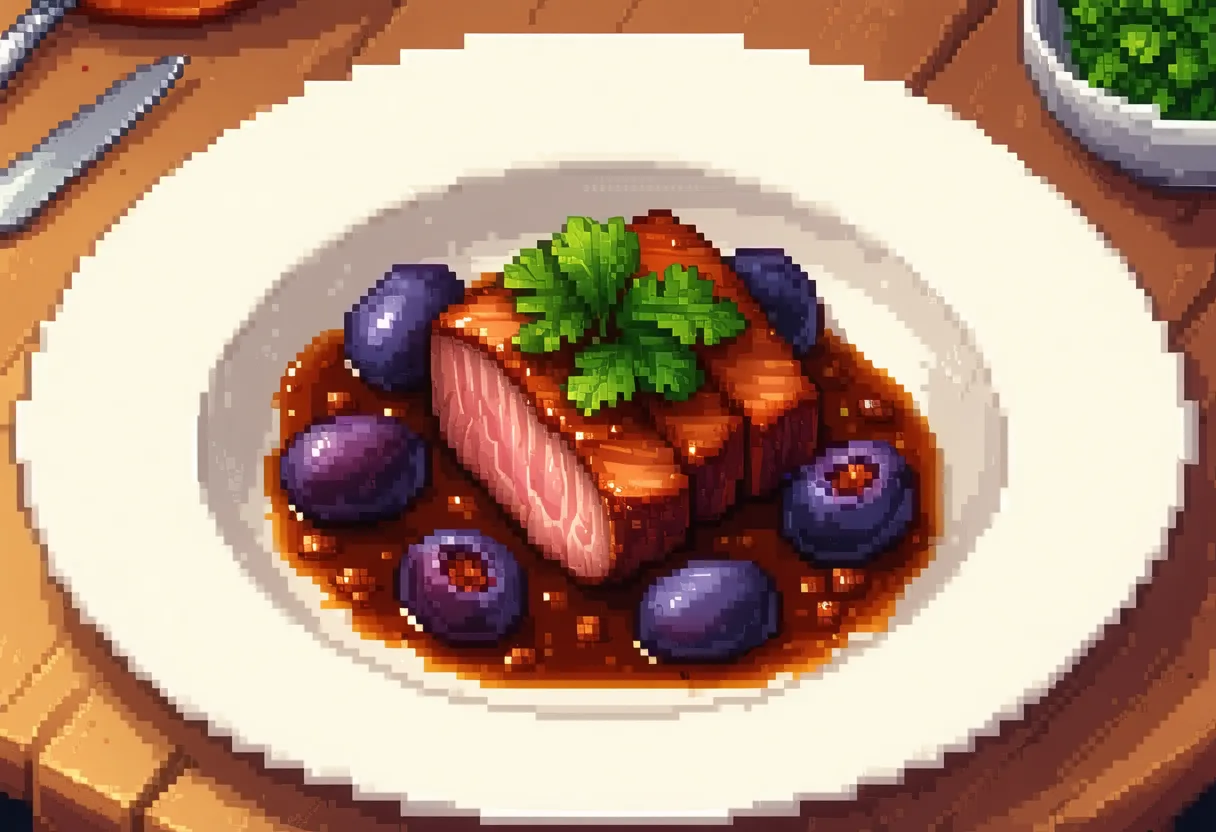
Pork Roast with Prunes
135 min · 14 steps
Hard: over 60 min or 12+ steps
About this dish
Dry-brining the pork overnight and deglazing with Armagnac before adding the braising liquid creates a sauce of extraordinary depth — the rendered fat and caramelised fond are what lift this classic Loire Valley dish above everyday pot roasts. The loin comes out the moment a probe confirms 63°C, the safe minimum for pork, then rests while the prunes plump in the sauce.
Allergy Info
Dairy, Celery, Sulphites, Mustard
Diet Info
Meat
Ingredients
Fresh Produce
- Carrotmedium, peeled and cut into 1cm rounds2 whole
- White onionlarge, finely diced1 whole
- Garlic clovesthinly sliced3 clove
- Fresh thyme2 sprig
- Flat-leaf parsleyfinely chopped1 tbsp
Meat & Poultry
- Pork Loin Roastboneless, tied at 3cm intervals1.2 kg
Dairy & Eggs
- Unsalted butter2 tbsp
Tins & Jars
- Chicken stockgood quality300 ml
Dried Goods
- Pitted prunesAgen200 g
Spices & Seasonings
- Fine sea salt1.5 tsp
- Black pepperfreshly ground0.5 tsp
- Bay leaf1 whole
Oils & Condiments
- Dry white wineVouvray or Muscadet200 ml
- Cognacor Armagnac60 ml
- Olive oilneutral oil, such as sunflower1 tbsp
- Dijon mustard1 tsp
Utensils
- Dutch Oven
- Meat thermometer
Method
Pat the pork loin completely dry with paper towels. Rub all surfaces evenly with the salt and black pepper. Place uncovered on a rack set over a tray.
Refrigerate the seasoned pork uncovered for 12–24 hours to dry-brine. Remove from the fridge 45 minutes before cooking to temper.
Combine the prunes and white wine in a small bowl and leave to soak for at least 30 minutes while you prepare the remaining ingredients.
Dice the onion, slice the garlic, and cut the carrots into rounds. Measure out the stock, Armagnac and mustard. Have all ingredients at the ready beside the stove.
Heat the oil in a large Dutch oven or heavy-based cocotte over high heat until shimmering. Add the pork loin and sear, turning every 2–3 minutes, until a deep mahogany crust forms on all sides — about 10–12 minutes total. Transfer the pork to a plate.
Reduce the heat to medium. Add the butter to the pot and, once foaming, add the onion and carrots. Cook, stirring occasionally, until the onion is softened and golden at the edges — about 7 minutes.
Add the garlic and cook, stirring, until fragrant — about 1 minute.
Remove the pot from the heat. Pour in the Armagnac and return to medium-high heat. Scrape up every bit of caramelised fond as the spirit bubbles and reduces — about 1 minute.
Add the chicken stock, thyme sprigs and bay leaf. Bring to a gentle simmer over medium heat.
Return the pork loin to the pot, nestling it among the vegetables. The liquid should come about one-third of the way up the meat. Cover with a tight-fitting lid and braise over very low heat, turning the pork once halfway through, until a meat thermometer inserted into the thickest part reads 63°C — the safe minimum for pork, approximately 60–70 minutes.
Lift the pork onto a carving board, tent loosely with foil, and rest for 15 minutes.
Add the prunes and their soaking wine to the braising liquid. Simmer over medium heat, uncovered, until the sauce is reduced by one-third and the prunes are plump and tender — about 15 minutes.
Stir in the Dijon mustard and taste for seasoning. Remove and discard the thyme sprigs and bay leaf.
Remove the kitchen twine from the pork. Slice into 1.5cm rounds and arrange on a warmed serving platter. Spoon the prunes and sauce over and around the meat, and finish with the chopped parsley.