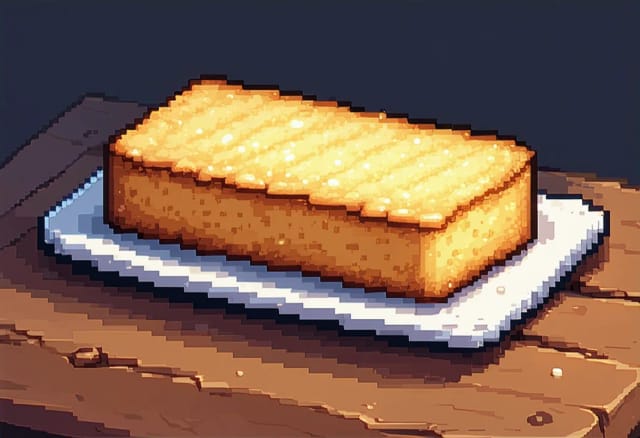
70min 4 ppl


73 min · 11 steps
Hard: over 60 min or 12+ steps
Laminated in the style of a Breton baker, this version builds its signature shatteringly crisp, caramelised crust by using a lean, slow-risen dough that gives gluten structure strong enough to withstand the aggressive folding of cold butter and sugar directly into the layers.
Dairy, Gluten
Vegetarian
Dairy & Eggs
Dried Goods
Spices & Seasonings
Combine the flour, yeast, and 5 g of the fine sea salt in a large bowl. Add the warm water and mix until a shaggy dough forms, then turn out onto an unfloured surface and knead for 8–10 minutes until smooth and slightly tacky but not sticky.
Shape the dough into a ball, place in a lightly oiled bowl, cover with a damp cloth, and leave to rise at room temperature for 1 hour, or until roughly doubled in size.
While the dough rises, place the cold butter slabs between two sheets of baking parchment and beat with a rolling pin into a rough 18 cm square. Refrigerate until needed.
Once risen, turn the dough onto a lightly floured surface and roll it into a 30 cm square. Place the cold butter square in the centre at a 45-degree angle like a diamond, fold the four dough flaps over to enclose it completely, and pinch the seams firmly to seal.
Roll the package into a 40 × 20 cm rectangle, keeping the butter cold and the surface lightly floured to prevent sticking. Fold the dough into thirds like a letter (one business-letter fold), wrap in cling film, and refrigerate for 30 minutes.
Remove from the refrigerator, unwrap, and sprinkle 60 g of the caster sugar and the remaining 3 g of fine sea salt evenly over the surface. Roll again to a 40 × 20 cm rectangle, pressing the sugar gently into the dough. Fold into thirds again, wrap, and refrigerate for a further 30 minutes.
Preheat the oven to 200°C fan (220°C conventional). Generously butter a 23 cm round cake tin or cast-iron skillet and scatter 60 g of the caster sugar across the base.
Remove the dough from the refrigerator and roll it into a rough circle slightly larger than your tin, about 25 cm across. Sprinkle the remaining 55 g of caster sugar evenly over the dough surface.
Carefully fold the dough in half, then in half again to form a rough quarter-circle, lift it into the prepared tin, and unfold it to fill the tin, tucking any overhang underneath. Scatter the flaky sea salt over the top. Leave uncovered at room temperature for 20 minutes to puff slightly.
Bake on the middle shelf for 35–40 minutes until the top is a deep mahogany brown and caramel is visibly bubbling up around the edges and pooling across the surface.
Remove from the oven and leave to rest in the tin for exactly 5 minutes — no longer — then invert immediately onto a wire rack set over a baking sheet. If any caramel remains in the tin, spoon it over the top while still liquid. Allow to cool for at least 20 minutes before cutting; the caramel crust must set to achieve the signature crisp layer.